
ASTM A182 F1 steel flanges are manufactured from low alloy steel containing chromium and molybdenum. This material grade is primarily intended for high-temperature and high-pressure service conditions. The presence of alloying elements improves strength, toughness, and resistance to creep. These flanges are produced through a forging process that enhances grain structure and mechanical integrity. ASTM A182 F1 flanges are widely accepted in critical piping systems. They comply with strict dimensional and chemical requirements. The grade is commonly used where thermal stability is essential. Its reliability makes it suitable for demanding industrial environments.
ASTM A182 F1 flanges are commonly used in power generation and petrochemical industries. They perform efficiently under elevated temperatures and fluctuating pressures. The chromium content improves oxidation resistance at higher operating temperatures. Molybdenum contributes to enhanced tensile strength and creep resistance. These flanges maintain structural stability over long service periods. They are preferred in applications where carbon steel may fail. Their forged construction ensures uniformity and durability. This makes them a dependable choice for critical installations.
The forging process used in ASTM A182 F1 flanges improves mechanical performance. Forging refines the grain structure and eliminates internal defects. This results in better impact strength and fatigue resistance. Compared to cast flanges, forged F1 flanges offer superior load-bearing capability. They are suitable for cyclic loading conditions. The manufacturing process follows ASTM standards strictly. Quality control includes heat treatment and testing. These steps ensure consistent performance in service.
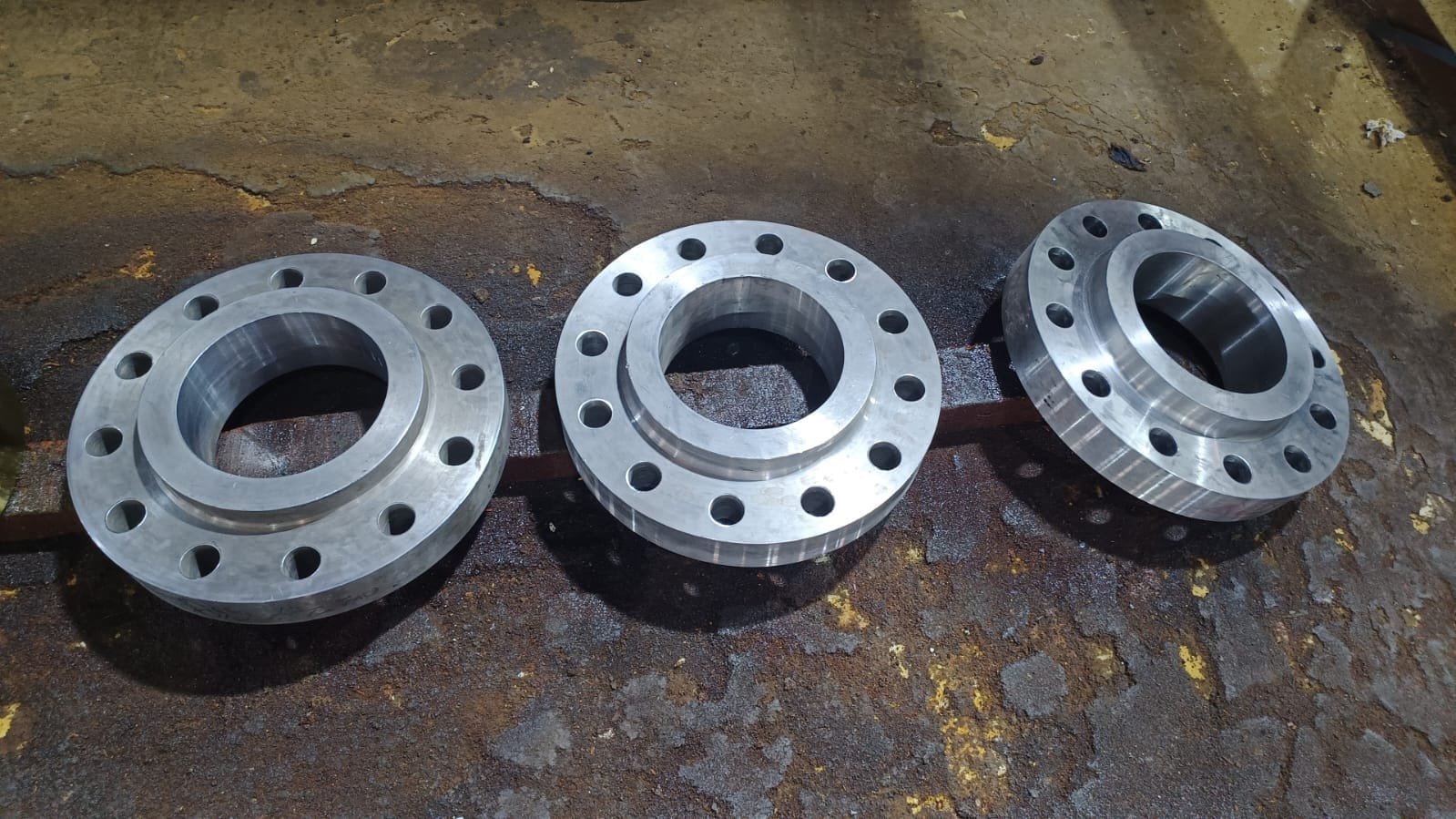
ASTM A182 F1 steel flanges are available in various pressure classes. Common classes include 150, 300, 600, 900, 1500, and 2500. Each pressure class is designed to handle specific operating conditions. Dimensional tolerances conform to ASME B16.5 and ASME B16.47 standards. This ensures easy compatibility with piping systems. Accurate dimensions simplify installation and alignment. Proper pressure ratings enhance system safety. These flanges are suitable for both moderate and severe services.
Different flange types are manufactured under ASTM A182 F1 specification. These include weld neck, slip on, blind, socket weld, and threaded flanges. Weld neck flanges provide excellent stress distribution. Slip on flanges offer ease of installation and cost efficiency. Blind flanges are used to close pipe ends securely. Socket weld and threaded flanges suit smaller diameter pipelines. Each type serves a specific functional requirement. This variety makes ASTM A182 F1 flanges highly versatile.
ASTM A182 F1 flanges exhibit good resistance to high-temperature oxidation. They are suitable for continuous operation in elevated thermal environments. The alloy composition prevents rapid degradation under heat exposure. These flanges also resist deformation under sustained loads. Their mechanical properties remain stable over time. This ensures long service life in harsh conditions. They are often used in steam lines and boilers. Thermal reliability is a key advantage of F1 material.
| Parameter | Details |
|---|---|
| Standard | ASTM A182 / ASME SA182 |
| Material Grade | ASTM A182 Grade F1 |
| Product Type | Forged Steel Flanges |
| Steel Type | Low Alloy Steel (Chromium-Molybdenum) |
| Manufacturing Process | Open Die Forging / Closed Die Forging |
| Pressure Ratings | Class 150, 300, 600, 900, 1500, 2500 |
| Flange Types | Weld Neck, Slip On, Blind, Socket Weld, Threaded, Lap Joint |
| Size Range | ½” to 48” (ASME B16.5 / ASME B16.47) |
| Dimensions Standard | ASME B16.5, ASME B16.47 Series A & B |
| Heat Treatment | Annealed / Normalized / Normalized & Tempered |
| Surface Finish | Raised Face (RF), Flat Face (FF), Ring Type Joint (RTJ) |
| Testing | Chemical Analysis, Mechanical Testing, NDT (UT/RT) |
| Certification | Mill Test Certificate as per EN 10204 3.1 |
| Applications | Power Plants, Oil & Gas, Petrochemical, Refineries, Pressure Vessels |
The chemical composition of ASTM A182 F1 flanges is carefully controlled. Chromium content typically ranges around 0.5%. Molybdenum content enhances strength at high temperatures. Carbon levels are kept low to improve weldability. Manganese and silicon support deoxidation and toughness. This balanced composition ensures optimal performance. It meets international material requirements. Consistency in chemistry guarantees predictable behavior. This is crucial for engineering applications.
Mechanical properties of ASTM A182 F1 flanges include high tensile strength. They also offer good yield strength and elongation values. Impact resistance remains stable at elevated temperatures. Proper heat treatment improves hardness and toughness. Normalizing and tempering are commonly applied processes. These treatments enhance overall durability. Mechanical testing ensures compliance with standards. Reliable strength characteristics support safe operation.
| Element | Composition (%) |
|---|---|
| Carbon (C) | 0.15 max |
| Manganese (Mn) | 0.30 – 0.60 |
| Phosphorus (P) | 0.035 max |
| Sulfur (S) | 0.040 max |
| Silicon (Si) | 0.50 – 1.00 |
| Chromium (Cr) | 0.30 – 0.60 |
| Molybdenum (Mo) | 0.10 – 0.20 |
| Property | Requirement |
|---|---|
| Tensile Strength | 415 – 585 MPa |
| Yield Strength (0.2% Offset) | 205 MPa min |
| Elongation | 20% min |
| Reduction of Area | 30% min |
| Hardness | 137 – 187 HB |
| Impact Test | As per ASTM A182 requirements (when specified) |
| Heat Treatment Condition | Annealed / Normalized / Normalized & Tempered |
| Testing Standard | ASTM A182 / ASME SA182 |
| Nominal Pipe Size (NPS) | Outside Diameter (OD) mm | Bolt Circle Diameter (BCD) mm | Number of Bolts | Bolt Size (mm) | Flange Thickness (mm) |
|---|---|---|---|---|---|
| 1/2" | 89 | 60 | 4 | M16 | 11 |
| 3/4" | 99 | 70 | 4 | M16 | 13 |
| 1" | 108 | 79 | 4 | M16 | 14 |
| 1½" | 127 | 99 | 4 | M16 | 16 |
| 2" | 152 | 120 | 4 | M19 | 18 |
| 3" | 191 | 152 | 4 | M19 | 21 |
| 4" | 229 | 190 | 8 | M19 | 24 |
| 6" | 279 | 241 | 8 | M22 | 26 |
| 8" | 343 | 298 | 8 | M22 | 29 |
| 10" | 406 | 362 | 12 | M25 | 32 |
| 12" | 483 | 432 | 12 | M25 | 35 |
| Standard | Equivalent Grade | Country / Organization |
|---|---|---|
| ASTM / ASME | A182 F1 / SA182 F1 | USA |
| EN | 16Mo3 | European Union |
| DIN | 16Mo3 (1.5415) | Germany |
| BS | BS 1501 622 | United Kingdom |
| IS | 15Mo3 | India |
| JIS | SCMV 1 | Japan |
| GB | 12CrMo | China |
ASTM A182 F1 Steel Flanges are forged carbon steel flanges designed for high-temperature and high-pressure service. They are widely used in pipelines, refineries, and chemical industries, providing durability, strength, and resistance to corrosion under normal operating conditions.
This standard includes flanges such as weld neck, slip-on, socket weld, threaded, lap joint, blind, and reducing flanges. Each type serves a specific purpose depending on the piping system design and installation requirements.
ASTM A182 F1 Steel Flanges are made primarily of carbon steel with controlled amounts of manganese, phosphorus, sulfur, and silicon. This composition ensures the flanges have excellent mechanical properties and can be heat-treated if required.
These flanges have high tensile strength, yield strength, and toughness. They are designed to withstand high pressures and temperatures, ensuring safe and reliable performance in industrial applications.
Yes, these flanges are suitable for welding. Proper welding procedures and preheating (if required) should be followed to prevent stress cracking and maintain structural integrity during service.
ASTM A182 F1 flanges are available in various pressure classes such as 150#, 300#, 600#, 900#, 1500#, and 2500#, in compliance with ASME B16.5 standards. Selection depends on the piping system’s operating pressure and temperature.
These flanges are available in sizes ranging from ½ inch to 48 inches in diameter, making them suitable for both small and large-scale industrial piping systems.
While ASTM A182 F1 is a carbon steel material, it has limited corrosion resistance. For corrosive applications, protective coatings, galvanization, or alloy steel alternatives are recommended to prevent premature failure.
These flanges undergo rigorous testing including hydrostatic pressure tests, dimensional inspections, ultrasonic testing, and surface defect checks to ensure compliance with ASTM and ASME standards.
Industries such as oil & gas, petrochemical, power generation, shipbuilding, and chemical processing frequently use ASTM A182 F1 flanges due to their reliability, high strength, and suitability for critical high-pressure and high-temperature applications.
We export steel pipes and tubes to over 60 countries worldwide, serving clients across Asia, Europe, the Middle East, Africa, Oceania, and the Americas. Our strong global logistics network ensures reliable delivery, quality assurance, and compliance with international standards.
Export Destinations Include:
Afghanistan, Albania, Andorra, Angola, Austria, Australia, Bahrain, Bangladesh,
Bhutan, Brazil, Brunei, Belarus, Belgium, Bulgaria, Cambodia, China, Cyprus,
Croatia, Czech Republic, Canada, Denmark, Estonia, Egypt, Finland, France,
Germany, Greece, Georgia, Hungary, Iceland, Ireland, Italy, Indonesia, Iran,
Iraq, Israel, Japan, Jordan, Kazakhstan, Kuwait, Kyrgyzstan, Lebanon, Latvia,
Latin America, Liechtenstein, Lithuania, Luxembourg, Malta, Madagascar, Mexico,
Moldova, Monaco, Malaysia, Maldives, Mongolia, Myanmar (Burma), Nepal,
New Zealand, North Korea, Netherlands, Norway, Nigeria, Oman, Poland, Portugal,
Pakistan, Palestine, Philippines, Qatar, Russia, Romania, San Marino,
Serbia and Montenegro, Slovakia, Slovenia, Spain, Sweden, Switzerland,
Saudi Arabia, Singapore, South Korea, South Africa, Sri Lanka, Sudan, Syria,
Taiwan, Tanzania, Tajikistan, Thailand, Turkey, Turkmenistan, Ukraine,
United Kingdom, United Arab Emirates (UAE), Uzbekistan, Venezuela, Vietnam,
Yemen, and more.

