
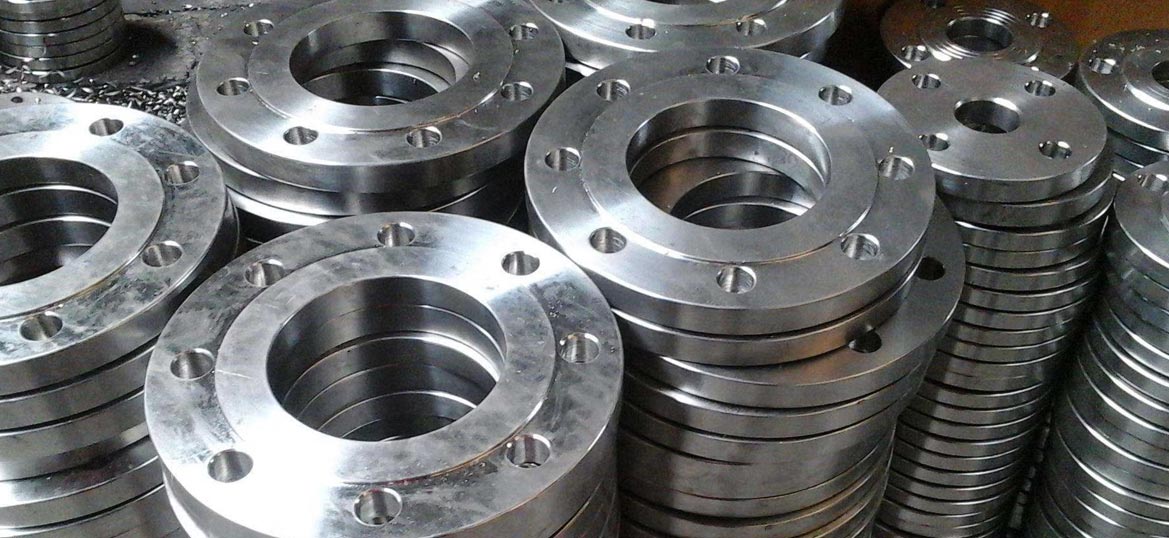
ASTM A182 F22 steel flanges are manufactured from chromium-molybdenum alloy steel and are designed for high-temperature and high-pressure services. These flanges are widely used in power generation, oil refineries, petrochemical plants, and gas processing units. The alloy composition provides superior mechanical strength and thermal stability. Forged construction ensures excellent grain flow and structural integrity. ASTM A182 F22 flanges perform reliably under severe operating conditions. They are commonly used in steam, hydrogen, and hydrocarbon applications. Their durability ensures long service life. Compliance with ASTM standards guarantees consistent quality.
The chemical composition of ASTM A182 F22 steel flanges is carefully controlled to achieve balanced performance. Chromium enhances oxidation and corrosion resistance at elevated temperatures. Molybdenum improves creep strength and resistance to high-temperature deformation. Carbon content is maintained to balance hardness and weldability. Manganese and silicon contribute to strength and deoxidation. Impurities such as sulfur and phosphorus are kept to minimal levels. This controlled composition ensures stable performance. It allows the flanges to withstand harsh service environments.
ASTM A182 F22 flanges exhibit excellent mechanical properties essential for pressure-retaining components. They provide high tensile and yield strength compared to lower alloy grades. These properties allow the flanges to handle high internal pressure safely. Adequate elongation ensures ductility during installation and service. Reduction of area values indicate good toughness. The mechanical reliability minimizes the risk of joint failure. These flanges maintain strength at elevated temperatures. This makes them suitable for critical industrial systems.
Heat treatment is a crucial process in the manufacturing of ASTM A182 F22 steel flanges. The material is typically supplied in normalized and tempered condition. This process refines the microstructure and enhances toughness. Heat treatment also reduces residual stresses from forging. Proper thermal processing improves resistance to cracking. It ensures uniform mechanical properties throughout the flange. Heat-treated F22 flanges perform consistently under thermal cycling. Strict adherence to heat treatment requirements is essential.
ASTM A182 F22 steel flanges are available in a wide range of sizes and pressure classes. Common pressure ratings include ASME Class 150, 300, 600, 900, 1500, and 2500. These flanges can be manufactured from small bore to large diameter sizes. Dimensional standards such as ASME B16.5 and ASME B16.47 are followed. Custom dimensions are also available to meet project requirements. Accurate sizing ensures proper alignment during installation. This flexibility supports complex piping systems. Standardization improves compatibility.
Various flange types are produced using ASTM A182 F22 material. These include weld neck, slip-on, socket weld, threaded, blind, and lap joint flanges. Weld neck flanges are preferred for high-pressure and high-temperature services. Slip-on flanges offer easier installation and lower cost. Socket weld flanges are suitable for small diameter pipelines. Threaded flanges are used where welding is not possible. Blind flanges are used to close pipeline ends. Each type serves a specific application.
| Specification – ASTM A182 F22 Steel Flanges | |
|---|---|
| Standard | ASTM A182 / ASME SA182 |
| Grade | F22 |
| Material Type | Chromium Molybdenum Alloy Steel |
| UNS Number | K21590 |
| Manufacturing Process | Forged |
| Product Forms | Weld Neck, Slip-On, Socket Weld, Threaded, Blind, Lap Joint |
| Size Range | ½″ to 48″ (Custom sizes available) |
| Pressure Class | ASME Class 150, 300, 600, 900, 1500, 2500 |
| Dimensional Standards | ASME B16.5, ASME B16.47 Series A & B |
| Face Type | Raised Face (RF), Ring Type Joint (RTJ), Flat Face (FF) |
| Heat Treatment | Normalized and Tempered |
| Testing | Chemical Analysis, Mechanical Testing, Hardness, NDT (if required) |
| Certification | Mill Test Certificate as per EN 10204 3.1 |
| Application | High Temperature & High Pressure Services |
ASTM A182 F22 flanges provide excellent resistance to oxidation and corrosion at elevated temperatures. Chromium content forms a protective oxide layer on the surface. This layer reduces scaling and metal loss during service. Molybdenum enhances resistance to localized corrosion and creep. These properties make F22 flanges suitable for aggressive process environments. They perform well in steam and chemical services. Improved corrosion resistance reduces maintenance requirements. This extends the service life of the piping system.
Weldability is an important factor when using ASTM A182 F22 steel flanges. Due to the alloy content, controlled welding procedures are required. Preheating is recommended to prevent thermal cracking. Post-weld heat treatment may be necessary depending on service conditions. Proper filler materials ensure metallurgical compatibility. Skilled welding practices result in strong, defect-free joints. Correct welding maintains mechanical properties. This ensures long-term joint integrity.
ASTM A182 F22 steel flanges are extensively used in power plants. They are installed in boiler systems, steam lines, and turbine piping. Oil and gas industries use these flanges for high-pressure process lines. Petrochemical plants rely on F22 flanges for reactors and heat exchangers. They are also used in hydrogen service applications. Their strength supports offshore and onshore installations. Chemical processing industries benefit from their durability. Wide usage reflects their reliability.
| Chemical Composition – ASTM A182 F22 Steel Flanges | |
|---|---|
| Element | Percentage (%) |
| Carbon (C) | 0.05 – 0.15 |
| Manganese (Mn) | 0.30 – 0.60 |
| Phosphorus (P) | 0.025 max |
| Sulfur (S) | 0.025 max |
| Silicon (Si) | 0.50 max |
| Chromium (Cr) | 2.00 – 2.50 |
| Molybdenum (Mo) | 0.90 – 1.10 |
| Nickel (Ni) | 0.40 max |
| Iron (Fe) | Balance |
| Mechanical Properties – ASTM A182 F22 Steel Flanges | |
|---|---|
| Tensile Strength | 415 MPa min (60 ksi min) |
| Yield Strength (0.2% Offset) | 205 MPa min (30 ksi min) |
| Elongation | 20% min |
| Reduction of Area | 30% min |
| Hardness | 217 HB max |
| Impact Test | As per ASTM A182 (when specified) |
| Heat Treatment Condition | Normalized and Tempered |
| Testing Temperature | Room Temperature |
| Dimension Chart – ASTM A182 F22 Steel Flanges (ASME B16.5) | |||||||
|---|---|---|---|---|---|---|---|
| Nominal Pipe Size (NPS) | Outside Diameter (OD) | Bolt Circle Diameter (BCD) | Flange Thickness (T) | Raised Face Height (RF) | Number of Bolt Holes | Bolt Hole Diameter | Pressure Class |
| 1/2" | 89 mm | 60 mm | 11 mm | 1.6 mm | 4 | 15 mm | 150 |
| 1" | 108 mm | 79 mm | 13 mm | 1.6 mm | 4 | 16 mm | 150 |
| 2" | 152 mm | 121 mm | 16 mm | 1.6 mm | 4 | 19 mm | 150 |
| 3" | 191 mm | 152 mm | 19 mm | 1.6 mm | 4 | 19 mm | 150 |
| 4" | 229 mm | 190 mm | 24 mm | 1.6 mm | 8 | 19 mm | 150 |
| 6" | 279 mm | 241 mm | 25 mm | 1.6 mm | 8 | 22 mm | 150 |
| 8" | 343 mm | 298 mm | 28 mm | 1.6 mm | 8 | 22 mm | 150 |
| 10" | 406 mm | 362 mm | 30 mm | 1.6 mm | 12 | 25 mm | 150 |
| Equivalent Grades – ASTM A182 F22 Steel Flanges | |
|---|---|
| Standard | Equivalent Grade |
| ASTM / ASME | ASTM A182 F22 / ASME SA 182 F22 |
| EN (European Standard) | EN 10222-2 10CrMo9-10 / EN 10028-2 10CrMo9-10 |
| DIN | DIN 17175 10CrMo9-10 |
| BS | BS 1501 622 |
| JIS | JIS G4051 SCM415 / SCM420 (Closest Equivalent) |
| ISO | ISO 9329-2 10CrMo9-10 |
| AFNOR | NF A 32-531 10CD9-10 |
| GB (China) | GB/T 3077 20CrMo (Approximate Equivalent) |
ASTM A182 F22 Steel Flanges are high-strength chromium-molybdenum alloy steel flanges designed for high-pressure and high-temperature applications. They are commonly used in power plants, petrochemical, oil & gas, and chemical industries due to their durability, heat resistance, and toughness.
This standard includes weld neck, slip-on, socket weld, threaded, lap joint, blind, and reducing flanges. Each type is designed to meet specific piping system requirements, ensuring reliable connections and optimal performance under high-pressure conditions.
ASTM A182 F22 flanges are made of chromium-molybdenum steel containing carbon, manganese, phosphorus, sulfur, silicon, chromium, and molybdenum. This composition provides excellent mechanical properties, high-temperature strength, and moderate corrosion resistance for industrial applications.
These flanges provide high tensile and yield strength, toughness, and hardness. They are suitable for withstanding high pressures and elevated temperatures, making them ideal for critical applications in refineries, chemical plants, and power generation facilities.
Yes, these flanges are suitable for welding. Proper welding procedures, including preheating and post-weld heat treatment, are essential to prevent cracking and maintain structural integrity under high-temperature service.
ASTM A182 F22 flanges are available in pressure classes including 150#, 300#, 600#, 900#, 1500#, and 2500# according to ASME B16.5 standards. Selection of the pressure class depends on the operating conditions and system design.
These flanges are available in sizes ranging from ½ inch to 48 inches, covering both small-diameter process piping and large industrial pipelines, providing versatility for various industrial applications.
The chromium-molybdenum composition provides moderate corrosion resistance. For highly corrosive environments, protective coatings or alloy alternatives may be necessary to ensure long service life and prevent premature deterioration.
ASTM A182 F22 flanges undergo hydrostatic testing, dimensional inspections, radiographic and ultrasonic testing, and hardness checks. These tests ensure compliance with ASTM and ASME standards, guaranteeing safety and reliability in high-pressure service.
Industries such as power generation, oil & gas, petrochemical, chemical processing, and shipbuilding use ASTM A182 F22 flanges for high-pressure and high-temperature piping systems due to their strength, heat resistance, and reliability in critical industrial applications.
We export steel pipes and tubes to over 60 countries worldwide, serving clients across Asia, Europe, the Middle East, Africa, Oceania, and the Americas. Our strong global logistics network ensures reliable delivery, quality assurance, and compliance with international standards.
Export Destinations Include:
Afghanistan, Albania, Andorra, Angola, Austria, Australia, Bahrain, Bangladesh,
Bhutan, Brazil, Brunei, Belarus, Belgium, Bulgaria, Cambodia, China, Cyprus,
Croatia, Czech Republic, Canada, Denmark, Estonia, Egypt, Finland, France,
Germany, Greece, Georgia, Hungary, Iceland, Ireland, Italy, Indonesia, Iran,
Iraq, Israel, Japan, Jordan, Kazakhstan, Kuwait, Kyrgyzstan, Lebanon, Latvia,
Latin America, Liechtenstein, Lithuania, Luxembourg, Malta, Madagascar, Mexico,
Moldova, Monaco, Malaysia, Maldives, Mongolia, Myanmar (Burma), Nepal,
New Zealand, North Korea, Netherlands, Norway, Nigeria, Oman, Poland, Portugal,
Pakistan, Palestine, Philippines, Qatar, Russia, Romania, San Marino,
Serbia and Montenegro, Slovakia, Slovenia, Spain, Sweden, Switzerland,
Saudi Arabia, Singapore, South Korea, South Africa, Sri Lanka, Sudan, Syria,
Taiwan, Tanzania, Tajikistan, Thailand, Turkey, Turkmenistan, Ukraine,
United Kingdom, United Arab Emirates (UAE), Uzbekistan, Venezuela, Vietnam,
Yemen, and more.

