
EN 57 Grade Steel Pipes are high-quality carbon steel pipes manufactured under the European Norm standard EN 57. These pipes are primarily designed for applications requiring moderate strength and good corrosion resistance. They are widely used in structural, mechanical, and general engineering applications. Their consistent chemical composition ensures uniformity in performance. EN 57 pipes are available in various dimensions and thicknesses to meet diverse industry requirements. The manufacturing process adheres to stringent quality control standards. They are suitable for both hot-rolled and cold-rolled applications. These pipes offer a balance between strength, ductility, and cost-effectiveness.
EN 57 Grade Steel Pipes are characterized by their specific chemical composition. They mainly consist of carbon (C), manganese (Mn), phosphorus (P), sulfur (S), and silicon (Si). Carbon content is controlled to provide moderate hardness while maintaining ductility. Manganese enhances strength and toughness, while phosphorus and sulfur are kept low to minimize brittleness. Silicon acts as a deoxidizer during manufacturing. This balanced composition ensures uniform mechanical properties. The chemical consistency also supports excellent weldability. Compliance with EN 57 standards guarantees pipes suitable for structural and pressure applications. Minor alloying elements may be present to improve performance further.
The mechanical properties of EN 57 Grade Steel Pipes include tensile strength, yield strength, elongation, and hardness. These pipes have moderate tensile strength, making them reliable for structural and mechanical applications. Yield strength ensures they can handle moderate stress without permanent deformation. The elongation percentage indicates good ductility, allowing bending and shaping without cracking. Hardness is optimized for durability while retaining machinability. These properties make EN 57 pipes versatile for both load-bearing and non-load-bearing applications. The uniform mechanical performance is achieved through controlled rolling and heat treatment. Pipes maintain integrity under moderate pressure and temperature conditions.
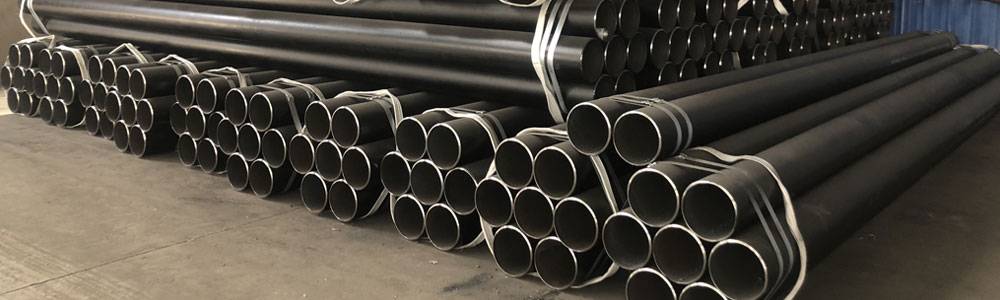
EN 57 Grade Steel Pipes are manufactured using both seamless and welded processes. Seamless pipes are produced by hot extrusion or rotary piercing, ensuring a smooth and uniform wall thickness. Welded pipes are made by forming steel sheets or strips and welding along the seam. Both processes undergo rigorous inspection to maintain dimensional accuracy. Heat treatment may be applied to relieve internal stresses. The surface is often cleaned and coated to prevent rusting during storage. Advanced quality checks ensure compliance with EN 57 specifications. The manufacturing process ensures high strength, durability, and resistance to wear and tear. Both types of pipes meet stringent European quality standards.
EN 57 Grade Steel Pipes are available in various surface finishes, including plain, galvanized, and painted. A smooth, uniform surface finish enhances aesthetic appeal and reduces friction in fluid transport applications. Galvanization improves corrosion resistance for outdoor or moist environments. Painted or coated finishes provide additional protection against oxidation and chemical exposure. Pipes undergo surface inspection to detect imperfections like cracks, dents, or scaling. The finishing process ensures long-term durability and performance. High-quality surface treatment also simplifies handling and installation. Pipes maintain their structural integrity even under challenging conditions. Surface finish selection depends on the application requirements.
EN 57 Grade Steel Pipes are widely used in construction projects. They serve as structural supports in buildings, bridges, and industrial frameworks. Their moderate strength makes them ideal for scaffolding, fencing, and handrails. These pipes are also used in concrete reinforcement for enhanced durability. Engineers prefer EN 57 pipes due to their reliable mechanical properties and uniform quality. They are suitable for both load-bearing and non-load-bearing structures. Their ease of fabrication and welding allows flexible design options. EN 57 pipes withstand moderate environmental exposure without significant degradation. They are a cost-effective choice for many construction applications.
| Property | Specification / Range | Unit | Remarks |
|---|---|---|---|
| Standard | EN 57 | - | European Norm for Carbon Steel Pipes |
| Material Type | Carbon Steel | - | Low to medium carbon content steel |
| Pipe Type | Seamless / Welded | - | Available in both manufacturing methods |
| Outer Diameter (OD) | 15 – 610 | mm | Standard EN 57 sizes |
| Wall Thickness | 2 – 40 | mm | Depending on pipe diameter |
| Length | 5 – 12 | m | Standard random or cut-to-length options |
| Yield Strength | ≥ 250 | MPa | Minimum yield strength as per EN 57 |
| Tensile Strength | 400 – 550 | MPa | Depends on diameter and manufacturing process |
| Elongation | ≥ 20% | % | Measured over 5.65√S0 gauge length |
| Hardness | ≤ 200 | HB | Brinell hardness for EN 57 pipes |
| Surface Finish | Plain / Galvanized / Painted | - | Depends on application and environment |
| Applications | Structural, Mechanical, General Engineering | - | Load-bearing and moderate stress applications |
| Compliance | EN 57 / ISO standards | - | Ensures quality, safety, and interchangeability |
In mechanical and engineering industries, EN 57 Grade Steel Pipes are used for shafts, rollers, and machinery components. Their uniform strength and ductility ensure reliability under stress. They can be machined, drilled, or welded according to design requirements. Pipes are used in automotive, agricultural, and industrial machinery. Moderate hardness ensures wear resistance while allowing bending or shaping. Their ability to maintain dimensional accuracy is crucial for precision applications. EN 57 pipes provide a balance of strength and toughness for mechanical uses. They are preferred where high-carbon steels may be unnecessarily hard or brittle. Their availability in various sizes adds versatility.
EN 57 Grade Steel Pipes are produced in a variety of diameters, wall thicknesses, and lengths. Standard dimensions comply with EN 57 specifications to ensure interchangeability and consistency. Both seamless and welded pipes are available in standard and customized sizes. Pipe dimensions are verified using strict quality control methods. Tolerances for diameter and wall thickness are maintained to meet engineering requirements. Lengths can be cut as per project needs without affecting structural integrity. Standardized sizing facilitates easy integration into pipelines or structural frameworks. Availability in multiple sizes enhances their suitability for diverse industrial applications.
EN 57 Grade Steel Pipes provide moderate corrosion resistance under normal environmental conditions. Their carbon steel composition is prone to oxidation but can be protected with coatings. Galvanization or painting significantly increases lifespan in humid or outdoor environments. Pipes can also be used in sheltered locations where corrosion is minimal. Regular maintenance and protective coatings are recommended for long-term durability. Resistance to environmental degradation ensures minimal structural weakening over time. In applications requiring higher corrosion resistance, additional surface treatments are applied. EN 57 pipes perform reliably in both indoor and outdoor conditions. Their corrosion resistance is adequate for most general-purpose applications.
| Element | Composition Range | Unit | Remarks |
|---|---|---|---|
| Carbon (C) | 0.17 – 0.22 | % | Controls hardness and strength; moderate carbon ensures ductility |
| Manganese (Mn) | 0.30 – 0.60 | % | Improves strength and toughness; assists deoxidation |
| Phosphorus (P) | ≤ 0.035 | % | Low content to minimize brittleness |
| Sulfur (S) | ≤ 0.035 | % | Low content to improve ductility and weldability |
| Silicon (Si) | 0.10 – 0.30 | % | Acts as a deoxidizer during steelmaking |
| Iron (Fe) | Balance | % | Main constituent of steel |
| Optional Alloying Elements | ≤ 0.20 (Ni, Cr, Cu) | % | Minor additions may improve corrosion resistance or mechanical properties |
| Property | Value / Range | Unit | Remarks |
|---|---|---|---|
| Yield Strength (Rp0.2) | ≥ 250 | MPa | Minimum stress the pipe can withstand without permanent deformation |
| Tensile Strength (Rm) | 400 – 550 | MPa | Ultimate tensile strength depending on diameter and manufacturing method |
| Elongation (A) | ≥ 20 | % | Indicates ductility; measured over a gauge length of 5.65√S0 |
| Reduction of Area (Z) | ≥ 35 | % | Represents material's ability to undergo plastic deformation |
| Hardness (Brinell, HB) | ≤ 200 | HB | Ensures machinability and moderate wear resistance |
| Impact Toughness (Charpy V-notch) | ≥ 27 | J | At room temperature; demonstrates resistance to sudden loading |
| Weldability | Excellent | - | Suitable for standard welding processes including MIG, TIG, and arc welding |
| Service Temperature | -20 to 400 | °C | Safe operating temperature range for structural applications |
| Nominal Diameter (DN) | Outer Diameter (OD) | Wall Thickness (WT) | Weight per Meter | Unit | Remarks |
|---|---|---|---|---|---|
| 15 | 21.3 | 2.0 | 0.59 | kg/m | Standard small diameter pipe |
| 20 | 26.9 | 2.3 | 0.93 | kg/m | Common for structural and fluid transport |
| 25 | 33.7 | 2.6 | 1.37 | kg/m | Small-medium size pipe |
| 32 | 42.4 | 2.6 | 1.68 | kg/m | Common in light structural applications |
| 40 | 48.3 | 3.0 | 2.11 | kg/m | Moderate size for mechanical installations |
| 50 | 60.3 | 3.2 | 2.78 | kg/m | Medium size pipe for various uses |
| 65 | 76.1 | 3.6 | 3.92 | kg/m | Widely used in structural frameworks |
| 80 | 88.9 | 4.0 | 5.02 | kg/m | Large diameter pipe for moderate load |
| 100 | 114.3 | 4.5 | 6.75 | kg/m | Common industrial pipe size |
| 125 | 139.7 | 4.8 | 9.01 | kg/m | Heavy-duty piping applications |
| 150 | 168.3 | 5.0 | 11.9 | kg/m | High load and structural usage |
| 200 | 219.1 | 5.6 | 17.7 | kg/m | Large industrial and mechanical applications |
| 250 | 273.0 | 6.3 | 26.4 | kg/m | Extra-large pipe for heavy structures |
| 300 | 323.9 | 7.1 | 34.6 | kg/m | Very large industrial pipe |
| 350 | 355.6 | 7.5 | 42.5 | kg/m | Special heavy-duty applications |
| 400 | 406.4 | 8.0 | 52.1 | kg/m | Structural and industrial usage |
| 500 | 508.0 | 9.0 | 71.2 | kg/m | Heavy piping for pressure and load-bearing systems |
| 600 | 610.0 | 10.0 | 94.5 | kg/m | Extra-large industrial and structural piping |
| Standard | Equivalent Grade | Unit / Notes | Remarks |
|---|---|---|---|
| EN 57 (Europe) | EN 10220 / EN 10216-1 | - | Seamless and welded carbon steel pipes |
| DIN (Germany) | ST 37-2 | - | Structural carbon steel with similar mechanical properties |
| BS (UK) | BS 1387 GR. B | - | Medium carbon steel pipe for general engineering |
| ASTM (USA) | A106 Gr. B / A53 Gr. B | - | Seamless and welded carbon steel pipes for high-temperature service |
| JIS (Japan) | STK 400 / STK 500 | - | Carbon steel pipes for structural and mechanical applications |
| IS (India) | IS 1239 Gr. B | - | Carbon steel pipes for general purpose and structural use |
| GOST (Russia) | ГОСТ 8732-78 | - | Seamless carbon steel pipes equivalent to EN 57 |
EN 57 Grade Steel Pipe is a high-quality carbon steel pipe manufactured according to the European standard EN 10216-2. It is widely used in high-pressure and high-temperature applications, offering excellent strength and durability.
EN 57 steel pipes typically contain carbon, manganese, phosphorus, sulfur, and silicon within strict limits to ensure mechanical strength and corrosion resistance. These pipes provide good weldability and formability for industrial applications.
The mechanical properties include a minimum yield strength of 355 MPa, tensile strength ranging from 490 to 630 MPa, and elongation of at least 20%. These properties make the pipes suitable for high-pressure systems and structural applications.
EN 57 Grade Pipes are available in a wide range of diameters from 21.3 mm to 660 mm and wall thickness from 2.6 mm to 60 mm. Custom sizes can also be manufactured according to project requirements.
Yes, EN 57 steel pipes have excellent weldability using all standard welding methods such as TIG, MIG, and arc welding. Preheating may be recommended for thicker sections to avoid cracking.
EN 57 Grade Steel Pipes are used in power plants, chemical industries, oil & gas pipelines, boilers, pressure vessels, and structural applications requiring high strength and resistance to pressure and temperature.
EN 57 steel pipes have higher tensile strength and yield strength compared to lower grades like EN 42 or EN 45. They are suitable for heavy-duty industrial applications where pressure, temperature, and mechanical load are critical.
Yes, EN 57 steel pipes can be used outdoors. However, it is recommended to apply protective coatings such as galvanizing or painting to prevent corrosion from environmental exposure.
All EN 57 pipes undergo strict quality tests including chemical composition analysis, tensile and yield strength tests, hydrostatic testing, and non-destructive testing (NDT) to ensure compliance with international standards.
EN 57 steel pipes should be stored in a dry, covered area, off the ground, and protected from moisture and corrosive elements. Proper storage ensures long-term durability and maintains mechanical integrity.
We export steel pipes and tubes to over 57 countries worldwide, serving clients across Asia, Europe, the Middle East, Africa, Oceania, and the Americas. Our strong global logistics network ensures reliable delivery, quality assurance, and compliance with international standards.
Export Destinations Include:
Afghanistan, Albania, Andorra, Angola, Austria, Australia, Bahrain, Bangladesh,
Bhutan, Brazil, Brunei, Belarus, Belgium, Bulgaria, Cambodia, China, Cyprus,
Croatia, Czech Republic, Canada, Denmark, Estonia, Egypt, Finland, France,
Germany, Greece, Georgia, Hungary, Iceland, Ireland, Italy, Indonesia, Iran,
Iraq, Israel, Japan, Jordan, Kazakhstan, Kuwait, Kyrgyzstan, Lebanon, Latvia,
Latin America, Liechtenstein, Lithuania, Luxembourg, Malta, Madagascar, Mexico,
Moldova, Monaco, Malaysia, Maldives, Mongolia, Myanmar (Burma), Nepal,
New Zealand, North Korea, Netherlands, Norway, Nigeria, Oman, Poland, Portugal,
Pakistan, Palestine, Philippines, Qatar, Russia, Romania, San Marino,
Serbia and Montenegro, Slovakia, Slovenia, Spain, Sweden, Switzerland,
Saudi Arabia, Singapore, South Korea, South Africa, Sri Lanka, Sudan, Syria,
Taiwan, Tanzania, Tajikistan, Thailand, Turkey, Turkmenistan, Ukraine,
United Kingdom, United Arab Emirates (UAE), Uzbekistan, Venezuela, Vietnam,
Yemen, and more.

