
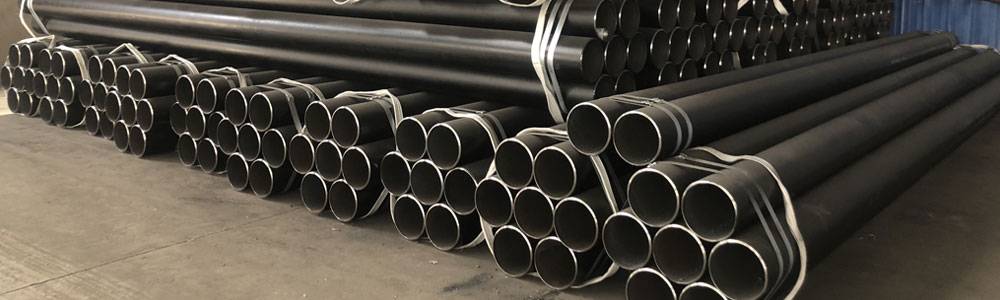
EN 58A Grade Steel Pipes are high-quality carbon steel pipes designed for use in various industrial and structural applications. These pipes are manufactured under strict European standards to ensure consistency, durability, and reliability. They are widely recognized for their excellent mechanical properties and corrosion resistance. EN 58A pipes are suitable for handling water, gas, and low-pressure steam. They provide an ideal solution for both domestic and industrial piping systems. The manufacturing process ensures precise dimensions and uniform wall thickness. They are widely used in chemical plants, power generation, and construction projects.
EN 58A Grade Steel Pipes are primarily composed of low-carbon steel, which enhances weldability and machinability. The steel contains a balanced amount of carbon, manganese, phosphorus, sulfur, and other trace elements. These elements provide the required strength while maintaining ductility. The chemical composition adheres strictly to EN 10216-2 standards. The low sulfur content ensures minimal risk of cracking during fabrication. Manganese increases hardenability and tensile strength. Overall, this composition ensures high performance under moderate stress and pressure.
The pipes are produced using either seamless or welded manufacturing techniques. Seamless pipes are created by piercing solid billets and then elongating them into pipes. Welded pipes are formed by rolling steel plates and fusing them longitudinally. Both processes ensure structural integrity and smooth surface finish. Pipes undergo heat treatment to relieve stresses and improve mechanical properties. Stringent quality checks, including ultrasonic testing and visual inspection, ensure defect-free pipes. The manufacturing ensures consistent dimensional tolerances and roundness.
EN 58A Grade Steel Pipes exhibit high tensile strength and good yield strength, making them suitable for pressure applications. They possess excellent impact resistance and toughness at room temperature. The pipes have good elongation, providing flexibility during installation. Hardness levels are controlled to ensure no brittleness under load. They maintain structural stability under thermal expansion and contraction. These mechanical properties make the pipes ideal for pipelines, boilers, and heat exchangers. They are also suitable for welded and flanged connections.
While EN 58A is not a stainless steel, it provides moderate resistance to corrosion in atmospheric and mild aqueous environments. The low sulfur and phosphorus content reduces susceptibility to pitting and scaling. When coated or painted, these pipes perform well in outdoor applications. They are suitable for water transport, oil pipelines, and industrial fluid systems. Galvanization or protective coatings further enhance durability. Proper maintenance extends the service life of these pipes.
EN 58A pipes are manufactured according to European standards, primarily EN 10216-2. They come in various diameters and wall thicknesses to meet specific project requirements. Lengths are standardized for easy handling and installation. Tolerances on diameter and wall thickness are strictly controlled to ensure compatibility with fittings and flanges. Seamless pipes typically have tighter tolerances than welded pipes. These standards ensure consistency and reliability for large-scale industrial systems.
| Specification | Details |
|---|---|
| Standard | EN 10216-2 |
| Grade | EN 58A |
| Type | Seamless Carbon Steel Pipes |
| Material | Low Carbon Steel |
| End Type | Plain End / Beveled End / Threaded End |
| Diameter Range | 21.3 mm – 610 mm (Outer Diameter) |
| Wall Thickness | 2.0 mm – 40 mm (varies by diameter) |
| Length | 6 m / 12 m or as per requirement |
| Surface Finish | Black / Painted / Galvanized |
| Mechanical Properties |
Tensile Strength: 450 – 600 MPa Yield Strength: ≥ 250 MPa Elongation: ≥ 20% |
| Test & Certification | Hydrostatic Test, Ultrasonic Test, Chemical & Mechanical Test Certificates |
| Applications | Pipelines, Water Transport, Gas Transport, Boilers, Heat Exchangers, Structural Applications |
EN 58A Grade Steel Pipes are extensively used in industrial sectors such as oil and gas, chemical processing, and power generation. They are ideal for conveying fluids and gases at moderate pressure and temperature. The pipes are also used in HVAC systems, water supply lines, and fire protection systems. Structural applications, such as scaffolding and framework, also benefit from their high strength. They are widely adopted in European and international projects for their reliable performance.
These pipes may undergo heat treatment processes such as normalizing, annealing, or quenching. Heat treatment improves mechanical properties and relieves internal stresses. It enhances toughness, ductility, and resistance to wear. Pipes can withstand moderate temperature variations without losing strength. Proper heat treatment ensures uniform performance across all batches. It also minimizes the risk of failure under pressure and reduces welding defects.
EN 58A pipes offer excellent weldability due to their low carbon content. Both manual and automated welding techniques can be applied. Pipes can be easily bent, flanged, or threaded without compromising structural integrity. Welding procedures must follow EN standards to ensure strong joints. Fabricators appreciate the predictable behavior of these pipes during bending and shaping. The pipes’ uniform microstructure ensures reliable performance after fabrication.
| Element | Percentage (%) |
|---|---|
| Carbon (C) | 0.17 – 0.22 |
| Manganese (Mn) | 0.35 – 0.65 |
| Phosphorus (P) | ≤ 0.035 |
| Sulfur (S) | ≤ 0.035 |
| Silicon (Si) | 0.10 – 0.35 |
| Chromium (Cr) | ≤ 0.30 |
| Nitrogen (N) | ≤ 0.012 |
| Property | Value |
|---|---|
| Tensile Strength (Rm) | 450 – 600 MPa |
| Yield Strength (ReH) | ≥ 250 MPa |
| Elongation (A) | ≥ 20% |
| Impact Strength | 27 J at 20°C (Charpy V-notch) |
| Hardness | ≤ 160 HB |
| Modulus of Elasticity (E) | ≈ 210 GPa |
| Density | ≈ 7.85 g/cm³ |
| Nominal Diameter (DN) | Outer Diameter (OD) mm | Wall Thickness (mm) | Weight (kg/m) |
|---|---|---|---|
| 15 | 21.3 | 2.0 – 3.2 | 1.2 – 1.8 |
| 20 | 26.9 | 2.3 – 3.6 | 1.7 – 2.6 |
| 25 | 33.7 | 2.6 – 4.0 | 2.3 – 3.4 |
| 32 | 42.4 | 2.6 – 4.5 | 3.2 – 4.8 |
| 40 | 48.3 | 2.9 – 4.8 | 3.8 – 5.5 |
| 50 | 60.3 | 3.2 – 5.0 | 5.0 – 7.1 |
| 65 | 76.1 | 3.6 – 5.5 | 6.5 – 9.8 |
| 80 | 88.9 | 4.0 – 6.3 | 8.5 – 13.0 |
| 100 | 114.3 | 4.5 – 7.1 | 12.0 – 18.5 |
| 125 | 139.7 | 4.8 – 8.0 | 16.5 – 25.0 |
| 150 | 168.3 | 5.0 – 8.8 | 22.0 – 32.0 |
| 200 | 219.1 | 5.6 – 9.5 | 33.0 – 51.0 |
| 250 | 273.0 | 6.3 – 11.0 | 51.0 – 81.0 |
| 300 | 323.9 | 7.1 – 12.5 | 72.0 – 111.0 |
| 350 | 355.6 | 7.6 – 14.0 | 90.0 – 140.0 |
| 400 | 406.4 | 8.0 – 15.0 | 115.0 – 180.0 |
| Standard | Equivalent Grade / Material |
|---|---|
| EN 10216-2 (Europe) | EN 58A |
| DIN (Germany) | St 35.8 / 1.0308 |
| BS (UK) | BS 3605 Grade 43A |
| ASTM (USA) | ASTM A106 Grade B / ASTM A53 Grade B |
| JIS (Japan) | STB 41 |
| IS (India) | IS 1239 Medium Class / IS 3589 |
| EN (Other European) | GS-45, P265GH (similar mechanical properties) |
EN 58A Grade Steel Pipes are seamless carbon steel pipes manufactured according to the EN 10216-2 standard. They are suitable for moderate pressure and temperature applications in industrial and structural systems.
The pipes are low-carbon steel with carbon 0.17–0.22%, manganese 0.35–0.65%, silicon 0.10–0.35%, phosphorus ≤ 0.035%, and sulfur ≤ 0.035%. Trace elements like chromium and nitrogen are also present in small amounts.
They have a tensile strength of 450–600 MPa, yield strength ≥ 250 MPa, elongation ≥ 20%, and impact toughness of 27 J at 20°C. The hardness is ≤ 160 HB, and modulus of elasticity is approximately 210 GPa.
EN 58A pipes come in diameters from 21.3 mm to 610 mm, with wall thickness ranging from 2.0 mm to 40 mm depending on the schedule and pressure requirement. Standard lengths are 6 m and 12 m, but custom lengths are available.
Yes, EN 58A pipes have excellent weldability due to their low carbon content. Both manual and automated welding methods can be used, following proper welding procedures.
They are widely used in pipelines, water and gas transport, boilers, heat exchangers, structural applications, and moderate-pressure industrial systems.
EN 58A pipes have moderate resistance to corrosion. They can be coated, painted, or galvanized for enhanced durability, especially in outdoor or humid environments.
Equivalent grades include ASTM A106 Grade B (USA), BS 3605 Grade 43A (UK), DIN St 35.8 (Germany), JIS STB 41 (Japan), and IS 1239 Medium Class (India).
EN 58A pipes undergo hydrostatic testing, ultrasonic inspection, mechanical tests for tensile and yield strength, elongation, impact tests, and chemical composition verification to ensure compliance with EN standards.
Pipes should be stored in dry, ventilated areas, stacked properly to avoid deformation, and handled carefully with cranes or forklifts. Protective coatings are recommended for long-term storage.
We export steel pipes and tubes to over 60 countries worldwide, serving clients across Asia, Europe, the Middle East, Africa, Oceania, and the Americas. Our strong global logistics network ensures reliable delivery, quality assurance, and compliance with international standards.
Export Destinations Include:
Afghanistan, Albania, Andorra, Angola, Austria, Australia, Bahrain, Bangladesh,
Bhutan, Brazil, Brunei, Belarus, Belgium, Bulgaria, Cambodia, China, Cyprus,
Croatia, Czech Republic, Canada, Denmark, Estonia, Egypt, Finland, France,
Germany, Greece, Georgia, Hungary, Iceland, Ireland, Italy, Indonesia, Iran,
Iraq, Israel, Japan, Jordan, Kazakhstan, Kuwait, Kyrgyzstan, Lebanon, Latvia,
Latin America, Liechtenstein, Lithuania, Luxembourg, Malta, Madagascar, Mexico,
Moldova, Monaco, Malaysia, Maldives, Mongolia, Myanmar (Burma), Nepal,
New Zealand, North Korea, Netherlands, Norway, Nigeria, Oman, Poland, Portugal,
Pakistan, Palestine, Philippines, Qatar, Russia, Romania, San Marino,
Serbia and Montenegro, Slovakia, Slovenia, Spain, Sweden, Switzerland,
Saudi Arabia, Singapore, South Korea, South Africa, Sri Lanka, Sudan, Syria,
Taiwan, Tanzania, Tajikistan, Thailand, Turkey, Turkmenistan, Ukraine,
United Kingdom, United Arab Emirates (UAE), Uzbekistan, Venezuela, Vietnam,
Yemen, and more.

