
EN 58J Grade steel pipes are high-quality carbon-manganese steel pipes widely used in the construction, engineering, and automotive industries. Designed for high pressure and temperature applications, these pipes exhibit excellent strength, toughness, and durability. The material conforms to the European Standard EN 10216, ensuring consistent quality and reliability. These pipes are suitable for mechanical and structural purposes and are available in various sizes, lengths, and thicknesses. EN 58J steel provides a good balance of tensile strength and ductility. Its robust chemical composition allows it to resist deformation under high-stress conditions. The seamless manufacturing process enhances uniformity and reliability. These features make EN 58J pipes ideal for critical industrial applications.
The chemical composition of EN 58J steel pipes is carefully controlled to ensure optimum mechanical properties. The steel primarily contains carbon, manganese, and small percentages of silicon, sulfur, and phosphorus. Carbon provides hardness and tensile strength. Manganese improves toughness and wear resistance. Silicon enhances strength and deoxidation. Phosphorus and sulfur are minimized to prevent brittleness. This precise chemical balance ensures EN 58J pipes perform reliably under pressure. It also allows them to withstand welding and forming processes. The composition is tested at every stage of manufacturing for consistency. These parameters make the pipes suitable for a wide range of industrial applications.
EN 58J steel pipes possess high mechanical strength and toughness, making them ideal for pressure-bearing applications. The tensile strength ranges from 500–650 MPa, while the yield strength is approximately 350 MPa. Elongation in 50 mm is typically 20% or more, providing excellent flexibility. Impact toughness at low temperatures ensures safe operation in cold climates. Hardness is controlled to meet industry standards without compromising ductility. The combination of strength and toughness allows these pipes to resist cracking under dynamic loads. EN 58J pipes are suitable for both structural and mechanical applications.
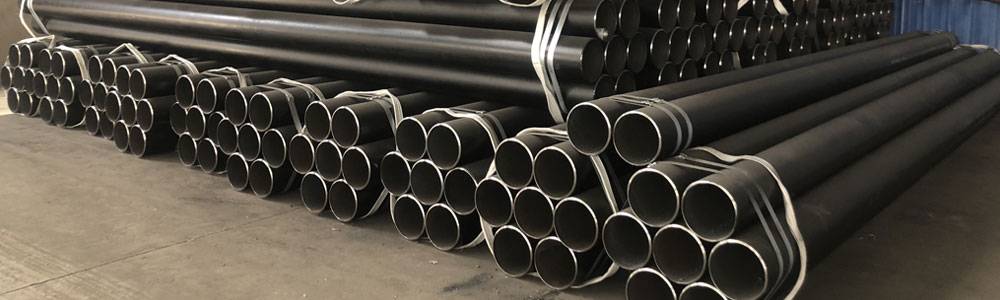
EN 58J steel pipes are produced using either seamless or welded techniques. Seamless pipes are manufactured by extrusion or rotary piercing of solid billets. Welded pipes are formed from steel strips and subjected to high-frequency welding. Both processes are followed by heat treatment to relieve stresses and enhance mechanical properties. Quality control includes dimensional checks, surface inspections, and non-destructive testing. These procedures ensure consistency, reliability, and compliance with EN standards. The manufacturing process makes these pipes suitable for high-pressure, high-temperature operations.
EN 58J grade steel pipes are available in a wide range of diameters and wall thicknesses. Standard diameters range from 21 mm to 610 mm. Wall thickness can vary from 2 mm to 50 mm or more, depending on application requirements. Lengths are typically supplied in 6 m or customized as per project needs. Pipes are supplied in both metric and imperial dimensions. Tolerances are strictly controlled to ensure compatibility with fittings and flanges. These dimensional standards make installation and assembly straightforward.
EN 58J steel pipes are used extensively in oil and gas, power generation, and chemical industries. They serve as pipelines for transporting water, oil, and gas. These pipes are also used in boilers, heat exchangers, and pressure vessels. Their strength and toughness make them suitable for structural frameworks and mechanical systems. They are commonly utilized in automotive components and heavy machinery. The versatility of EN 58J pipes allows them to meet diverse industrial requirements efficiently.
| Property | Specification / Value | Unit / Standard |
|---|---|---|
| Steel Grade | EN 58J | EN 10216 |
| Pipe Type | Seamless / Welded | - |
| Outside Diameter (OD) | 21 – 610 | mm |
| Wall Thickness | 2 – 50 | mm |
| Length | 6, 12 or as per requirement | m |
| Yield Strength | ≥ 350 | MPa |
| Tensile Strength | 500 – 650 | MPa |
| Elongation | ≥ 20 | % in 50 mm |
| Impact Toughness | ≥ 27 | J at -20°C |
| Surface Finish | Hot rolled / Pickled & Oiled | - |
| End Type | Plain / Beveled / Threaded | - |
| Test & Inspection | Hydrostatic Test, UT, PMI, Dimensional Check | EN 10216 / ISO |
| Applications | Oil & Gas, Boilers, Pressure Vessels, Structural | - |
| Certification | Mill Test Certificate (MTC) as per EN 10204 | - |
EN 58J steel pipes can be heat-treated for enhanced strength and toughness. Normalizing, quenching, and tempering are common methods used to improve mechanical properties. The pipes are also compatible with various welding techniques, including TIG, MIG, and arc welding. Proper welding ensures joints retain mechanical strength and resistance to corrosion. Post-weld heat treatment may be applied to relieve residual stresses. These features make EN 58J pipes suitable for fabricating complex assemblies.
Although EN 58J steel pipes are primarily carbon-manganese steels, they can be coated or painted to resist corrosion. Common protective methods include galvanizing, epoxy coating, or polyurethane paint. Proper corrosion protection extends the service life of pipes, especially in outdoor or chemical environments. The base steel provides moderate resistance to atmospheric corrosion. Maintenance and surface treatment are critical in aggressive conditions. This makes EN 58J pipes suitable for both indoor and outdoor installations.
EN 58J steel pipes offer a combination of high strength, toughness, and versatility. They are reliable under high pressure and temperature. Seamless manufacturing ensures uniformity and eliminates weak points. The pipes are easy to machine, bend, and weld. Their dimensional accuracy ensures easy integration with industrial systems. Heat treatment enhances performance without compromising ductility. EN 58J pipes also offer cost-effective solutions for long-term applications.
| Element | Percentage (%) | Notes / Standard |
|---|---|---|
| Carbon (C) | 0.17 – 0.23 | Provides strength and hardness |
| Manganese (Mn) | 0.60 – 0.90 | Improves toughness and wear resistance |
| Silicon (Si) | 0.10 – 0.35 | Strengthening and deoxidizing agent |
| Phosphorus (P) | ≤ 0.035 | Minimized to prevent brittleness |
| Sulfur (S) | ≤ 0.035 | Minimized to improve weldability |
| Chromium (Cr) | 0.10 – 0.25 | Optional, enhances corrosion resistance |
| Nickel (Ni) | ≤ 0.30 | Optional, improves toughness at low temperatures |
| Copper (Cu) | ≤ 0.30 | Enhances corrosion resistance |
| Aluminum (Al) | 0.015 – 0.060 | Deoxidizer, improves steel cleanliness |
| Property | Value / Range | Unit / Notes |
|---|---|---|
| Yield Strength (ReH) | ≥ 350 | MPa |
| Tensile Strength (Rm) | 500 – 650 | MPa |
| Elongation (A50) | ≥ 20 | % in 50 mm |
| Impact Toughness (Charpy V-notch) | ≥ 27 | J at -20°C |
| Hardness (Brinell) | ≤ 200 | HB |
| Reduction of Area (RA) | ≥ 50 | % |
| Bending Test | Pass | Pipe can be bent 180° without cracks |
| Fatigue Strength | As per EN 10216 | High-cycle endurance |
| Pressure Resistance | Hydrostatic test: 1.5×PN | PN = Nominal Pressure |
| Nominal Pipe Size (NPS) | Outside Diameter (OD) | Wall Thickness | Inside Diameter (ID) | Length |
|---|---|---|---|---|
| 1/2" | 21.34 mm | 2.77 – 4.78 mm | 15.78 – 15.80 mm | 6 m / 12 m / Custom |
| 1" | 33.40 mm | 3.38 – 5.49 mm | 22.42 – 26.64 mm | 6 m / 12 m / Custom |
| 2" | 60.33 mm | 3.91 – 8.74 mm | 42.85 – 52.51 mm | 6 m / 12 m / Custom |
| 4" | 114.30 mm | 6.02 – 13.49 mm | 87.32 – 102.26 mm | 6 m / 12 m / Custom |
| 6" | 168.28 mm | 7.11 – 18.26 mm | 131.76 – 154.06 mm | 6 m / 12 m / Custom |
| 8" | 219.08 mm | 8.18 – 23.01 mm | 173.06 – 202.72 mm | 6 m / 12 m / Custom |
| 10" | 273.05 mm | 9.27 – 28.58 mm | 215.89 – 254.51 mm | 6 m / 12 m / Custom |
| 12" | 323.85 mm | 9.53 – 33.32 mm | 257.21 – 304.79 mm | 6 m / 12 m / Custom |
| Standard | Equivalent / Comparable Grade | Country / Organization | Remarks |
|---|---|---|---|
| EN | EN 58J | European Union | Carbon–Manganese structural steel grade |
| DIN | DIN 1.0570 (St 52) | Germany | High-strength structural steel |
| ASTM | ASTM A106 Grade B | USA | Seamless carbon steel pipe for high temperature |
| ASTM | ASTM A53 Grade B | USA | Pressure and structural applications |
| BS | BS 970 080M40 | United Kingdom | Medium carbon steel with good strength |
| JIS | JIS G4051 S45C | Japan | Carbon steel for mechanical use |
| ISO | ISO E355 | International | Structural and pressure applications |
| GB | GB/T 8162 45# | China | Structural and mechanical tubing |
EN 58J Grade Steel Pipe is a non-alloy structural steel pipe manufactured in accordance with European standards. It offers good strength, weldability, and toughness, making it suitable for general engineering and structural applications.
The number “58” represents the approximate minimum tensile strength in kgf/mm², while “J” indicates that the material has been impact tested at standard temperature conditions, ensuring adequate toughness.
EN 58J Steel Pipes are commonly used in construction, structural frameworks, mechanical engineering, scaffolding, pressure vessels, and general fabrication where moderate strength and durability are required.
Yes, EN 58J Grade Steel Pipes have good weldability. Standard welding processes such as MIG, TIG, and arc welding can be used without special pre-heating under normal conditions.
EN 58J Steel Pipes typically offer good tensile strength, yield strength, and impact resistance. These properties make them reliable for load-bearing and structural applications.
EN 58J Steel Pipes are not inherently corrosion resistant. For corrosive environments, protective coatings such as galvanizing, painting, or epoxy coating are recommended.
EN 58J Steel Pipes are available in seamless and welded forms, supplied in a wide range of diameters, wall thicknesses, and lengths as per project requirements.
EN 58J Steel Pipes are primarily designed for structural and general engineering use. For high-pressure applications, pressure-grade standards should be considered.
Common equivalent grades include ASTM A36, IS 2062 E250, and DIN St 52, depending on specific mechanical and chemical requirements.
EN 58J Steel Pipes undergo chemical analysis, tensile testing, impact testing, and dimensional inspection to ensure compliance with applicable standards and quality requirements.
We export steel pipes and tubes to over 58j countries worldwide, serving clients across Asia, Europe, the Middle East, Africa, Oceania, and the Americas. Our strong global logistics network ensures reliable delivery, quality assurance, and compliance with international standards.
Export Destinations Include:
Afghanistan, Albania, Andorra, Angola, Austria, Australia, Bahrain, Bangladesh,
Bhutan, Brazil, Brunei, Belarus, Belgium, Bulgaria, Cambodia, China, Cyprus,
Croatia, Czech Republic, Canada, Denmark, Estonia, Egypt, Finland, France,
Germany, Greece, Georgia, Hungary, Iceland, Ireland, Italy, Indonesia, Iran,
Iraq, Israel, Japan, Jordan, Kazakhstan, Kuwait, Kyrgyzstan, Lebanon, Latvia,
Latin America, Liechtenstein, Lithuania, Luxembourg, Malta, Madagascar, Mexico,
Moldova, Monaco, Malaysia, Maldives, Mongolia, Myanmar (Burma), Nepal,
New Zealand, North Korea, Netherlands, Norway, Nigeria, Oman, Poland, Portugal,
Pakistan, Palestine, Philippines, Qatar, Russia, Romania, San Marino,
Serbia and Montenegro, Slovakia, Slovenia, Spain, Sweden, Switzerland,
Saudi Arabia, Singapore, South Korea, South Africa, Sri Lanka, Sudan, Syria,
Taiwan, Tanzania, Tajikistan, Thailand, Turkey, Turkmenistan, Ukraine,
United Kingdom, United Arab Emirates (UAE), Uzbekistan, Venezuela, Vietnam,
Yemen, and more.

